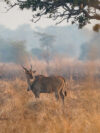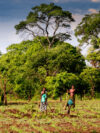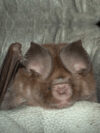
Research is the cornerstone of our conservation efforts at Nsanga Conservation Zambia. We conduct ecological and social research to guide conservation strategies. Our studies focus on species richness and occupancy, ecological trends, population dynamics of key species, landcover changes and social factors impacting local communities. Lastly, we also engage with international institutions to make scientific research in the Luangwa Valley more accessible.
Ecological Research:
Population monitoring
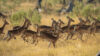
We monitor herbivores, carnivores and birds in Luambe National Park to detect trends, assess population structures and their characteristics. This data is vital to identify population declines and their underlying drivers in a timely manner. Such trends may also reflect the effectiveness of implemented conservation efforts. The monitoring of priority carnivore species and the Luangwa’s endemic Thornicroft’s giraffe are led by our partner organisations Zambian Carnivore Programme and Giraffe Conservation Foundation.
Biodiversity Monitoring
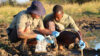
Utilizing various research tools including eDNA, camera trapping, bioacoustics and remote sensing, we presence / absence, occupancy and species richness in our operational areas. This data aids in understanding ecosystem characteristics and dynamics.
Land Cover Changes
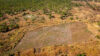
Using satellite-imagery and drone footage, we track changes in land cover and land use, such as from habitat encroachment, bushfires or foraging pressure. This helps us monitor larger scale changes in habitats and observe encroachment levels, informing conservation planning.
Scientific Projects
We engage in scientific research partnerships with universities, institutes, organizations and independent researchers to enhance our ecological research output. International research collaborations always include partnerships with local Zambian universities.
Social Research:
Community Household Surveys
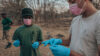
Regular surveys are conducted to understand the socio-economic status and challenges faced by local communities, guiding our community support initiatives.

Human-Wildlife Conflict Research
Social research is conducted to identify problem species and assess the impact of human-wildlife conflicts on crops, livestock, and property. This informs the development of mitigation strategies.


Copperbelt University
Our research is conducted in close collaboration with the School of Natural Resources at the Copperbelt University, a Zambian university that offers diverse biology and conservation-related courses. In addition, we also involve local members from the surrounding communities in our projects. This way, we boost both our scientific work as well as support local capacity building.