
Birding Gems of Luambe National Park
Luambe National Park, sitting in the heart of the Luangwa Valley, is much smaller than its neighbours South and North Luangwa National Parks. However, the high variety of habitats within the ~300 km2 are home to a large diversity of birds. From the riverine forest along the Luangwa River, the park stretches to the East through mopane woodland, floodplains – which dry up in summer – lagoons and miombo woodland.
Over 250 species have been recorded in the park, some of which are known to be “birding gems”; rare species that are difficult to spot and require patience to witness due to special behavioural patterns and elusive nature.
You’ll hear them before you see them
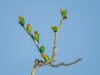
Whether you are driving around the park or sitting by the river, you will hear many species calling. A very charismatic species you can find in Luambe in high numbers are the Lilian’s lovebirds (Agapornis lilianae). They can be found from the river to the plains, and their high-pitch calls will reach you before you spot their bright green feathers camouflaged in the green leaves of the trees and bushes. Although in lower numbers, the Meyer’s parrot (Poicephalus meyeri) can also be found in the park, especially among the large mopane trees (Colophospermum mopane).
Follow the water
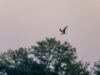
The Luangwa and its riverine forest offer the perfect setting for species that feed off the river and use fallen trees and bushes on the riverbanks as shelter. At dawn, the African skimmer (Rynchops flavirostris) flies just above the water surface, and when the night falls, species such as the white-backed night heron (Calherodius leuconotus) or Pel’s fishing owl (Scotopelia peli) come out of their roosting spots to feed. The banks of the Luangwa river also provide breeding sites to a variety of bee eater species, including hundreds of Southern Carmine Bee-Eaters (Merops nubicoides), which arrive in August to build their nests.
Keep your eyes open and practice your identification skills
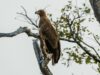
Waterbirds and waders, raptors, nocturnal specialists or colourful foliage birds are all part of the different landscapes of the park. This dry season, we had the privilege of encountering a juvenile palm-nut vulture (Gypohierax angolensis), an unusual species which is not commonly found in the Luangwa Valley. Due to its brown plumage, it can easily be misidentified with other raptors.
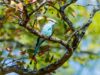
Another special encounter that has become a common localized sighting are the racket-tailed rollers (Coracias spatulatus), only found in specific parts of the park with large mopane trees. Although similar to their more common relatives the lilac-breasted rollers (Coracias caudatus), their tails have long wired feathers that end with a characteristic spatule form.
For us as Nsanga, this is the first year we are conducting bird surveys inside the park. As there is no previous data, we are starting by focusing on raptors, oxpeckers, parrots and Southern carmine bee-eaters. We hope to gather baseline data that can be updated yearly to identify population trends and learn about species habitat needs to guide conservation actions. Check out our upcoming post blogs to find more about how we monitor the different bird families.
